Header-less Menu
Martijn van Welie
Users need to access the main sections of the site
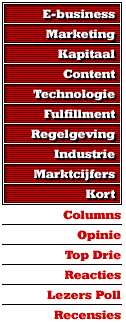
From
www.emerce.nl
The information
structure of the site has two or more parts. The main part serves the primary
purpose of the site. The other parts are more or less independent of the main
part and serve a secondary purpose. The main part typically has too many
sections for a horizontal menu and must therefore be displayed vertically. Most
users will need to see the main part first.
Combine menus in a vertical menu using different visual
clues instead of headers
The main part is placed at the top and has an accent visually so that
it is perceived as the main part of the site. The other parts have a modest
appearance so that they do not compete for attention with the main part.
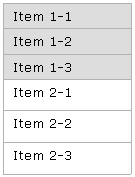
> open wireframe <
Since the main part contains many items, it should be displayed
vertically. This rules out a horizontal menu for the remaining parts so they
must be displayed vertically as well. The vertical order and the visual design
are important to communicate the differences in importance. An important
advantage is the fact that no separate headings are needed for the parts.
This example from the Financieel Dagblad site shows two sections.
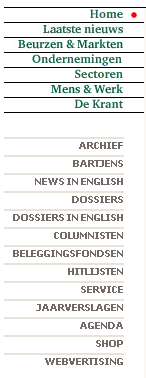 www.fd.nl;
Consider a combination of horizontal menu and a right-hand vertical
menu when the main section is small.
www.fd.nl;
Consider a combination of horizontal menu and a right-hand vertical
menu when the main section is small.